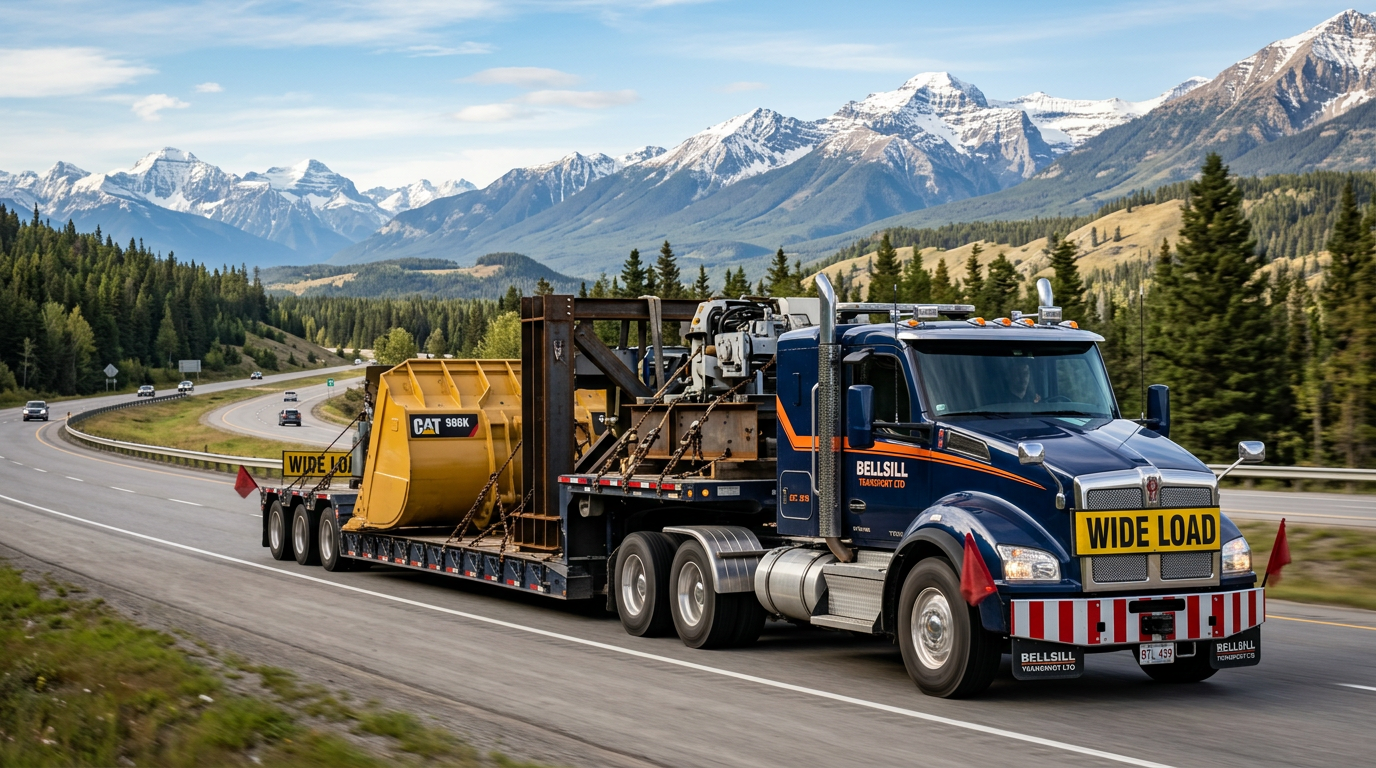
Alberta's Oilfield Transport Landscape: A Guide for Energy Sector Operators
The Alberta oil and gas sector encompasses one of the world's most geographically diverse and operationally demanding freight environments. From the remote muskeg of the Athabasca Oil Sands to the conventional well pads of Central Alberta, the salt cavern storage facilities of the Cold Lake region, and the sour gas processing plants of the foothills, oilfield freight flows through an intricate network of highways, secondary roads, and lease roads that require specialized knowledge to navigate safely and legally.
Key Oilfield Transport Regions in Alberta
Athabasca Oil Sands Region (Fort McMurray / Wood Buffalo): The epicentre of Alberta's oil sands industry. Open-pit mining and SAGD (Steam-Assisted Gravity Drainage) operations require massive volumes of equipment, materials, and supplies transported primarily along Highway 63 (the "Highway to Resources") from Edmonton. This 4-hour, 450-km corridor is one of the busiest heavy truck routes in Canada. Oil sands operations also require significant module haul activity — prefabricated facility components moved in oversize configurations from fabrication yards in Edmonton and Nisku to site.
Peace Country (Grande Prairie / Dawson Creek Regions): The Montney and Duvernay formations in the Peace Country represent some of Canada's most active unconventional resource plays. Extensive pipeline infrastructure, compression facilities, and active drilling programs generate consistent freight demand. Highway 43 (the Yellowhead from Edmonton to Grande Prairie) is the primary freight corridor for this region.
Central Alberta (Red Deer / Pembina / Ponoka Corridor): Conventional oil production from the Pembina, Cardium, and Viking formations. Dense well infrastructure with established road networks. Lower per-load complexity but high frequency of regular supply runs to active wells and battery sites.
Lloydminster / Cold Lake / Heavy Oil Belt: The heavy oil and bitumen production region straddling the Alberta-Saskatchewan border. SAGD operations, cold heavy oil production with sand (CHOPS), and polymer flood projects all have significant oilfield supply needs. Lloydminster serves as a regional transport hub for the area's petroleum operations.
Foothills / Rocky Mountain Trend: Primarily sour gas production zones requiring HAZMAT-qualified drivers and special safety protocols. Deep formations with high-pressure, high-temperature wells requiring specialized drilling and completion equipment transport.
H2S Safety Requirements for Oilfield Transport in Alberta
Hydrogen sulfide (H2S) is a naturally occurring toxic gas found in many Alberta oil and gas formations. The Petroleum Industry Human Resources Council (PetroHR) and industry standard bodies require that all personnel — including truck drivers — accessing wellsite and sour gas areas have current H2S Alive certification.
H2S Alive is an 8-hour safety training program covering:
- Physical and chemical properties of hydrogen sulfide
- Detection and monitoring of H2S using personal monitors
- Protection from H2S including SCBA (Self-Contained Breathing Apparatus) use
- Rescue procedures for H2S incidents
- Site muster point procedures and evacuation protocols
All BellSill Transport drivers working in oilfield environments maintain current H2S Alive certification, renewed every 3 years per industry requirements. This credential is verified at site check-in and is non-negotiable for entry to sour gas wellsites and processing facilities.
Working with Oil Company Safety Management Systems
Major oil and gas operators in Alberta — Suncor, Cenovus, Imperial, Canadian Natural Resources, Husky (now Cenovus), Shell, and others — require that contractors and transportation providers meet specific safety pre-qualification standards before being permitted to work for them. These systems include:
- ISNetworld (ISN): One of the most widely used contractor management systems in the oil sands. Contractors must upload safety statistics, policies, and training records to their ISN profile, which operators review before awarding contracts.
- Complyworks: Another widely used contractor management platform used by multiple Alberta oil companies.
- Avetta (formerly PICS): Used by some operators for contractor prequalification management.
- Operator-specific requirements: Many oil companies have additional site-specific orientations, contractor safety management requirements, and drug and alcohol testing programs.
BellSill Transport maintains profiles on the major contractor management platforms used by Alberta oil and gas operators and can provide our safety statistics, insurance documentation, and driver certifications as required by client operators' contractor management requirements.
Oil Sands Module Transport: Alberta's Most Complex Freight Challenge
Oil sands module transport represents the pinnacle of oilfield freight complexity. Prefabricated process modules for SAGD facilities and open-pit extraction plants are manufactured at fabrication yards in the Edmonton Industrial Heartland (Nisku, Leduc, Fort Saskatchewan) and moved north on Highway 63 to oil sands sites. These modules can be:
- Width: 7–9 metres (requiring police escort through urban sections, multiple pilot cars)
- Height: 5–7 metres (requiring utility line lifts and high-load escorts)
- Length: 30–80 metres (requiring stretch equipment and potentially 2-truck push-pull configurations)
- Weight: 200–2,000+ tonnes (requiring Schnabel or SPMT equipment with 100+ axle lines)
BellSill Transport has experience coordinating large oil sands module moves and works with specialized heavy transport partners for the most extreme dimensional loads, providing project management and logistics coordination throughout these complex multi-day operations.
Emergency Oilfield Transport: When Every Hour Costs Thousands
Oil rig standby costs in Alberta range from $10,000 to over $50,000 per day, depending on rig type and crew size. When a critical component fails or a required part is delayed, operators face a very simple calculation: the cost of emergency transport is a fraction of the cost of continued downtime. BellSill Transport's 24/7 emergency oilfield dispatch line exists precisely for these moments.
Common emergency oilfield transport scenarios we respond to:
- Critical drilling equipment failures requiring same-day parts delivery to remote wellsites
- Emergency chemical deliveries for well control situations
- Urgent pipe delivery for completion operations
- Emergency fuel delivery to remote site generators
- Unexpected rig move requirements due to operational changes
- Equipment recovery from stuck or abandoned wellsites