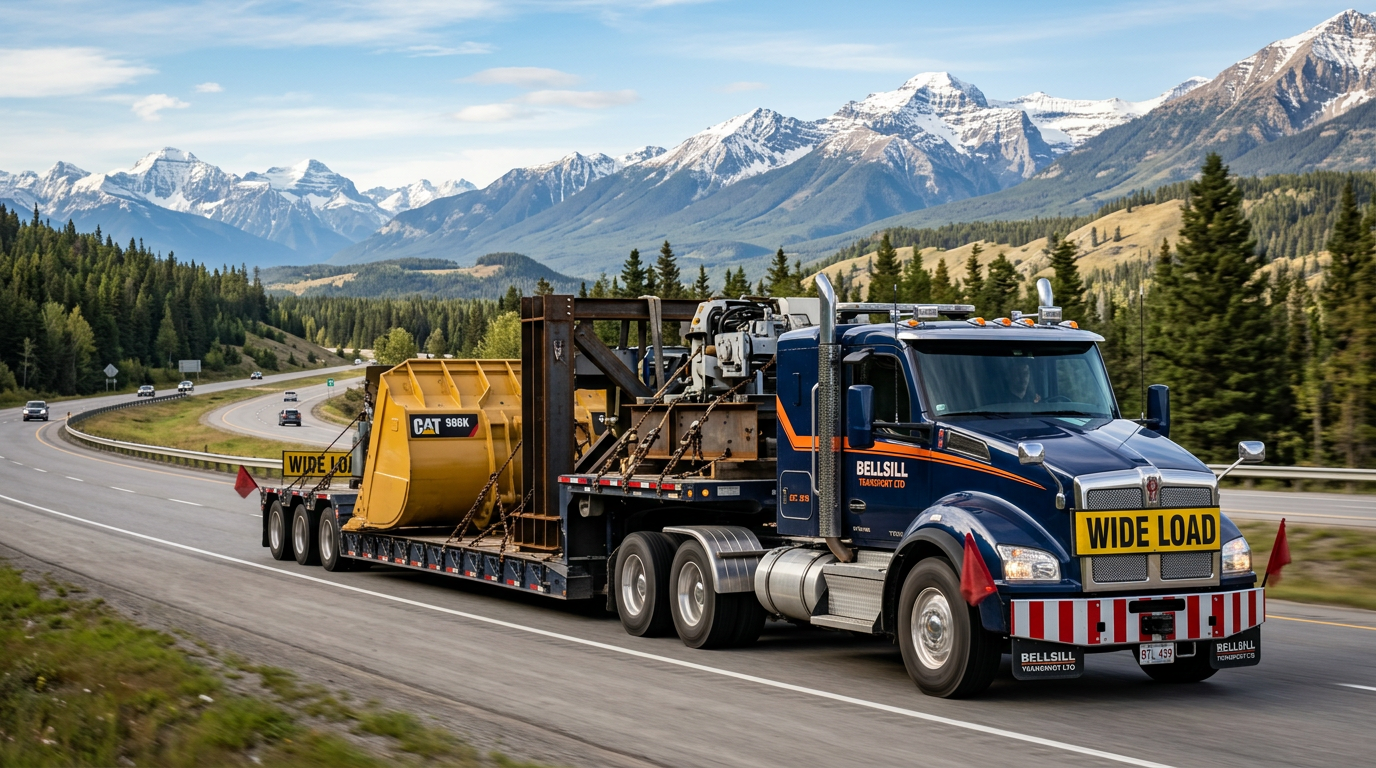
Oversize Load Transport in Alberta: The Complete Regulatory Guide
Alberta has one of Canada's most comprehensive frameworks for governing oversize and overweight vehicle movements on public roads. Understanding this regulatory landscape is essential for shippers and contractors planning to move cargo that exceeds standard legal limits. BellSill Transport's permit specialists are experts in Alberta's SVC system and handle all compliance requirements on behalf of our clients.
Alberta Legal Dimension Limits — Standard Vehicles
Any vehicle or combination exceeding the following standard legal limits in Alberta requires a Special Vehicle Combination (SVC) permit:
| Dimension | Legal Limit | Max with Permit |
|---|
| Width | 2.6 metres (8'6") | Up to 5.0 metres |
| Height | 4.15 metres (13'7") | Up to 6.5 metres |
| Overall Length | 23.0 metres | Route-dependent |
| Gross Vehicle Weight | Up to 62,500 kg (axle-dependent) | Up to 200,000+ kg with engineering |
Types of SVC Permits in Alberta
Alberta Transportation issues several types of Special Vehicle Combination permits depending on load characteristics and frequency of movement:
- Single-trip permits: For one-time oversize movements on a specified route and date. Most common for large industrial equipment moves. Typically issued within 1–5 business days.
- Annual permits: For businesses that regularly move oversize loads on the same or similar routes. Reduces per-trip administrative cost significantly. Requires proof of equipment and load specifications.
- Special authorizations: For exceptionally large loads (typically over 5 metres wide or extremely heavy), a Special Authorization is required in addition to standard SVC permits. These require formal engineering review and may involve the Ministry of Transportation directly.
- Research permits: For load configurations not covered by standard permit categories, requiring detailed engineering submissions and potentially Alberta Transportation field inspections.
Pilot Car Requirements in Alberta
Alberta Transportation mandates pilot car (escort vehicle) requirements based on load width, and sometimes height and length. General requirements:
- Width 3.2m to 4.9m: Front escort required on most routes
- Width over 4.9m: Both front and rear escorts required
- Height over 5.3m: High-load escort vehicle with height pole required
- Length over 40m: Additional escort requirements on certain route types
- Structure crossings: Some bridge crossings require pilot cars regardless of load dimensions
Alberta pilot car operators must be licensed, carry proper insurance, and have appropriate safety equipment including amber lights, signage, height poles (for high loads), and radio communication equipment. BellSill Transport works with a network of licensed pilot car operators across Alberta and neighbouring provinces to ensure coverage on any route our heavy haul trucks travel.
Route Surveys and Pre-Move Planning
For complex oversize moves — particularly very wide loads (over 4.0m) or extremely heavy loads — a route survey is conducted before the actual move. BellSill Transport's route survey process includes:
- Physical reconnaissance of the proposed route, identifying low overhead obstructions, narrow sections, sharp curves, and grade challenges
- Bridge rating verification — confirming that bridges on the route can accommodate the proposed load weight, using Alberta Infrastructure bridge rating data
- Utility company notifications for overhead power, telephone, or cable lines that may need to be temporarily raised for load passage
- Municipal approval for moves through incorporated areas, as some loads require police escort through urban sections
- Determination of optimal travel window (time of day, day of week) to minimize traffic disruption and risk
Common Oversize Loads We Transport in Alberta
BellSill Transport's heavy haul division has extensive experience with the following cargo types that are regularly transported oversize in Alberta:
- Oil sands modules: Pre-fabricated plant components for SAGD and open-pit mining operations in the Athabasca region, often exceeding 8 metres in width and hundreds of tonnes in weight
- Power transformers: Utility transformers for electrical substations, typically 3.5–5.0 metres wide and weighing 50–400 tonnes
- Wind turbine components: Nacelles, towers, and blades for wind energy projects across Alberta's wind corridors
- Pressure vessels and reactors: Industrial chemical processing equipment for refineries and upgraders
- Mining equipment: CAT 793, 797, and similar ultra-class haul trucks disassembled for transport to mine sites
- Large construction cranes: Tower cranes, crawler cranes, and all-terrain cranes mobilized to construction sites
- Industrial generators: Large diesel generators for remote power generation and emergency backup systems
- Structural steel and bridge sections: Pre-fabricated steel structures, bridge girders, and truss sections
Spring Road Bans: Planning Oversize Moves Around Alberta's Seasonal Restrictions
Alberta's spring road bans (typically March through May) significantly restrict the movement of heavy vehicles on secondary roads and many primary highways as the seasonal thaw weakens pavement structures. Oversize moves must be carefully planned to:
- Complete all heavy or wide load movements before spring road ban season begins
- Or delay movements until road ban season ends and full weight limits are restored
- In some cases, obtain special exemptions from Alberta Transportation for critical infrastructure or emergency moves
- Plan alternative routes that avoid road ban restrictions where possible
BellSill Transport's logistics coordinators monitor Alberta's seasonal restriction schedules and proactively advise clients planning oversize moves near the spring road ban period.